
A personal loan can be useful for debt consolidation, home repairs, medical bills, major purchases or other planned expenses. It can also become expensive if you choose quickly without reading the details. Before you submit a formal application, use the comparison process below to narrow your choices with more confidence.
Start With Your Own Borrowing Profile
Before comparing lenders, define what you actually need from the loan. This keeps you from being pulled toward the largest loan amount, the longest term or the flashiest advertised offer.
Start with four numbers: the loan amount you need, the monthly payment you can afford, the payoff timeline you prefer and your current credit profile. If the loan is for debt consolidation, also list the balances, APRs and minimum payments on the debts you want to combine. A consolidation loan only helps if the new loan improves your cost, simplifies repayment or creates a realistic payoff path.
Your credit score, income, debt-to-income ratio and employment history can affect which personal loan lenders are likely to approve you and what rate they may offer. If you are still deciding whether a personal loan is the right tool, MoneyLendings has a broader complete guide to personal loans that explains common loan types, uses and repayment basics.
Compare APR, Not Just the Interest Rate
The annual percentage rate, or APR, is usually the best starting point because it reflects the yearly cost of borrowing, including interest and certain required fees. The interest rate tells you what the lender charges for borrowing money, but APR gives a more complete view of cost.
For example, two lenders might both advertise a 12% interest rate. If one charges a large origination fee and the other does not, their APRs may be different. That difference matters because it affects how much the loan really costs over time.
When reviewing lenders, look for the APR range, whether the rate is fixed or variable and whether the lowest advertised rate is limited to borrowers with excellent credit. Most personal loans use fixed rates, but you should still confirm this before signing. A fixed rate gives you predictable monthly payments, which makes budgeting easier.
If you want a deeper explanation of how APR affects loan cost, review MoneyLendings’ guide to understanding interest rates before you borrow.
Look Beyond the Monthly Payment
A low monthly payment can be appealing, especially if your budget is tight. The problem is that a lower payment often comes from a longer repayment term, and a longer term usually means paying more total interest.
Here is a simple illustration using a $10,000 personal loan. These numbers are approximate and do not include every possible lender fee, but they show why term length and APR both matter.
| Loan scenario | Approximate monthly payment | Approximate total repaid | What it shows |
|---|---|---|---|
| $10,000 for 36 months at 12% APR | $332 | $11,957 | Shorter term, higher payment, lower total cost |
| $10,000 for 60 months at 12% APR | $222 | $13,347 | Lower payment, longer payoff, higher total cost |
| $10,000 for 36 months at 18% APR | $362 | $13,015 | Higher APR increases total cost even with the same term |
The best loan is not always the one with the smallest payment. It is the one that balances affordability with the lowest reasonable total cost. If the payment is too high, you risk late fees or missed payments. If the term is too long, you may pay more than necessary.
Review Fees Carefully
Fees can change the value of a loan, even when the APR looks competitive. Some personal loan lenders charge few or no extra fees. Others charge fees that can affect how much cash you receive and how much you pay back.
Common fees to compare include:
- Origination fee, which may be deducted from the loan proceeds before funds are sent to you
- Late payment fee, which applies if you miss the due date or grace period
- Returned payment fee, which may apply if a payment fails due to insufficient funds
- Prepayment penalty, which is less common for personal loans but still worth checking
- Paper check or manual payment fee, which some lenders may charge depending on payment method
Origination fees deserve special attention. If you borrow $10,000 with a 5% origination fee deducted upfront, you may receive $9,500 but still repay the full $10,000 plus interest. APR should help reflect that cost, but you should also ask how much money will actually be deposited into your account.
Check Prequalification Options Before a Hard Application
Many lenders offer prequalification, which can estimate your potential rate, loan amount and term before you submit a full application. Prequalification usually uses a soft credit inquiry, which does not affect your credit score. Always confirm this with the lender before entering your information.
A formal application typically triggers a hard credit inquiry. A hard inquiry can affect your credit score, so it makes sense to narrow your list before applying. Prequalification is not a guarantee of approval. The lender still needs to verify your identity, income, credit report and other application details.
This step is especially useful if your credit is not perfect. Borrowers with fair credit may see wider differences between lender offers, fees and approval requirements. MoneyLendings covers that situation in more detail in its guide to best personal loans for fair credit.
Compare Eligibility Requirements
Eligibility requirements help you avoid wasting time with lenders that are unlikely to fit your situation. Some lenders focus on borrowers with strong credit. Others may consider additional factors such as income, education, employment history or existing banking relationships.
Look for requirements related to minimum credit score, income, debt-to-income ratio, citizenship or residency, state availability and accepted income types. Also check whether the lender allows a co-borrower or co-signer if you need one. A co-borrower may improve approval odds or pricing, but both borrowers are responsible for repayment.
If a lender does not clearly explain its requirements, that is not automatically a deal breaker, but it does mean you should ask questions before applying. The goal is to avoid multiple hard applications with lenders that were never a realistic match.
Evaluate Repayment Flexibility and Customer Experience
The loan experience does not end when the money arrives. You may be dealing with the lender or loan servicer for two to seven years, depending on the term. That makes repayment tools, customer support and account management more important than they may seem during the application process.
Compare how each lender handles payment due dates, autopay options, payment changes, payoff quotes and customer service. If the lender offers an autopay discount, confirm whether the discount is included in the quoted APR or only applies after enrollment. Also ask how payments are applied if you pay extra toward principal.
Customer support matters most when something goes wrong. A lender with a slightly lower rate may not be worth it if billing support is hard to reach or account information is unclear. Review the lender’s website, disclosures and customer service options before accepting an offer.
You can also check complaint patterns through the Consumer Financial Protection Bureau’s consumer complaint database. A few complaints do not necessarily mean a lender is bad, especially if it serves many borrowers, but repeated issues around payments, credit reporting or unclear fees are worth noting.
Watch for Personal Loan Red Flags
Legitimate lenders should be transparent about rates, fees, repayment terms and approval requirements. Be cautious if a company promises guaranteed approval, pressures you to act immediately or asks for unusual payment methods before funding the loan.
The Federal Trade Commission warns consumers about personal loan scams, including lenders that demand upfront fees, ask for payment by gift card or wire transfer or claim that credit history does not matter at all. Real lenders may work with a range of credit profiles, but they still need to evaluate your ability to repay.
Other warning signs include vague contact information, no clear privacy policy, poor grammar in official messages, no physical business details and reluctance to provide written loan terms. If anything feels rushed or unclear, pause before sharing sensitive personal information.
Use a Side-by-Side Comparison Worksheet
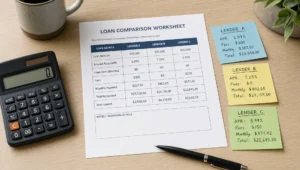
A simple worksheet helps you compare offers without relying on memory or marketing language. Fill in the same fields for every lender so you can see the true differences.
| Comparison item | What to record | Why it matters |
|---|---|---|
| Requested loan amount | The amount you want to borrow | Keeps every offer comparable |
| Approved loan amount | The amount the lender is willing to offer | May differ from your request |
| APR | The annual cost including interest and certain fees | Best starting point for cost comparison |
| Origination fee | Percentage or dollar amount | Affects cash received and total cost |
| Loan term | Number of months or years | Impacts payment size and total interest |
| Monthly payment | Required payment each month | Shows budget fit |
| Total repayment amount | Principal, interest and fees over the full term | Shows the true cost of the loan |
| Prepayment rules | Whether extra payments or early payoff cost money | Important if you plan to repay early |
| Funding timeline | When funds may be available after approval | Matters for urgent expenses |
| Customer support | Phone, chat, email or branch availability | Helps if payment issues arise |
This worksheet is also useful when comparing an online lender with a bank or credit union. Online lenders may offer fast prequalification and funding. Banks may offer relationship benefits to existing customers. Credit unions may offer competitive rates for members. The right choice depends on your approval odds, total cost and comfort with the repayment process.
Compare Loan Purpose Rules
Not every lender allows every loan purpose. Many personal loans can be used for debt consolidation, home improvement, medical expenses or major purchases, but restrictions vary. Some lenders do not allow personal loans for college tuition, business expenses, investing or certain prohibited uses.
Be honest about the purpose when you apply. If you are consolidating debt, check whether the lender can pay creditors directly or whether funds will be deposited into your account. Direct creditor payment can simplify consolidation, but you should still verify that old accounts are paid off and closed only if closing them supports your broader credit plan.
Decide What Matters Most for Your Situation
Once you have several offers, rank them by the factors that matter most to you. For many borrowers, the top priority is the lowest APR with no unnecessary fees. For others, the deciding factor may be a lower monthly payment, the ability to add a co-borrower or a funding timeline that meets an urgent need.
A strong comparison usually weighs these factors in order:
- Total cost of borrowing, including APR and fees
- Monthly payment fit within your budget
- Eligibility match and approval likelihood
- Repayment flexibility and prepayment rules
- Lender transparency, support and complaint history
Do not borrow more than you need just because a lender approves a larger amount. Extra borrowing increases interest cost and can make future financial goals harder to reach. A personal loan should solve a specific problem, not create room for more spending.
Before You Apply, Read the Final Disclosures
Prequalified offers can change after the lender reviews your full application. Before accepting a loan, read the final loan agreement and Truth in Lending disclosures carefully. Confirm the APR, finance charge, payment schedule, fees, due date, funding amount and total of payments.
If the final offer is worse than expected, you do not have to accept it. You can compare other lenders, reduce the loan amount, choose a different term or wait until your credit or income improves. A slower decision can be better than an expensive one.
Frequently Asked Questions
How many personal loan lenders should I compare before applying? Comparing at least three lenders is a practical starting point. Include different lender types when possible, such as an online lender, a bank and a credit union, so you can compare pricing, approval requirements and repayment options.
Does prequalification hurt my credit score? Prequalification usually uses a soft credit inquiry, which does not affect your credit score. A formal loan application typically requires a hard inquiry, so confirm the lender’s process before submitting your information.
Should I choose the lender with the lowest APR? The lowest APR is often the best cost indicator, but it should not be the only factor. Also compare fees, loan term, monthly payment, prepayment rules, funding timeline and customer support.
What is the biggest mistake to avoid when comparing lenders? The biggest mistake is focusing only on the monthly payment. A longer term can lower the payment but increase total interest. Always compare the total repayment amount before accepting an offer.
Are online personal loan lenders safe? Many online lenders are legitimate, but you should verify transparency, licensing information, clear disclosures, secure application pages and customer complaint patterns. Avoid lenders that guarantee approval or demand upfront payment by unusual methods.
Compare With Confidence Before You Borrow
The right lender is the one that offers a loan you can afford, understand and repay without unnecessary cost. Take time to compare APRs, fees, terms, eligibility requirements and repayment support before submitting a full application.
MoneyLendings offers personal loan education, rate comparison information, loan partner resources and calculators to help you make a more informed borrowing decision. Start with the resources at MoneyLendings and compare your options before you apply.